Sunday, 4 November 2018

The gypsy in me


Perhaps everyone has within them the desire to wander, fancy-free. I certainly have and believe that I know the best way to achieve it. However, please don’t tell anyone the secret since there are already too many in the know – it’s via that king of the road: the motor caravan. Ah, you might think, real gypsies do not own motor caravans; they travel around in those wonderful horse drawn caravans shaped like a fat, lower-case ‘i’. And of course some do, but most do not.

When I wrote The Battle for Stow some years ago I interviewed gypsies who were attending the Stow Horse Fair, that controversial coming together of the tribes beloved by the travellers and feared by many of the residents. It was not an easy task since many of them were, rightly, suspicious of snoopers. However, one man did have a smart motor caravan and to help break the ice I told him I owned one too.

“What ya got?” he asked with interest, so I told him the make and model.

“Wanna sell ‘er?” he retorted instantly.

Not surprising perhaps since trading is what the fair is mostly about – and some of the gypsies I met confessed that they also have proper houses like the rest of us.

We have just returned from a ten day holiday from our Spanish village in the motor caravan. Some friends find this odd, assuming that a holiday is what we go to Spain for, whereas to us it is just another place where we live. The trip started in Spain then on to southern Portugal, after that to the UK and finally back to Spain – all in the motor caravan and without flying or taking ferries.
As usual the trip involved the very minimum of planning; the main objective being to explore Portugal which we reached on the second day. Arriving quite late we found, purely by accident, the walled city of Elvas and a convenient overnight spot in a car park in nearby club land where we parked opposite the local pigeon fanciers club.

The defensive walls of Elvas are unusual in that looking from above they form a star-like shape rather than the usual rectangle or circle – interesting. And, as we walked through the narrow archway into the city (definitely not motor caravan friendly), we were thrilled to find a fascinating web of even narrower streets, many leading up to the grand central plaza dominated by a fine white church. Elvas was a charming introduction to Portugal and there we dined on Portuguese pork and golden fish washed down with local wine and - no port.

The following days fell into our usual pattern. I went for a run whilst Margaret prepared breakfast; we showered then chose some destination from the map that looked interesting. We then drove there mostly by secondary roads, having lunch in the van at some nice spot along the way. On arrival we searched for a parking place big enough for the van, explored the place and if we liked it stayed, later finding a bar then a restaurant and so to sleep. If we did not much like a place we travelled on and sometimes had to find somewhere to park up for the night in darkness which can be difficult.

Our best night was spent overlooking a wonderful bay on the Atlantic coast a few K from the small inland village of Carrapteira. There we sat in the wind-buffeted van watching the sun set over the ocean then gradually spreading its fiery red illumination across the whole sky whilst we drank red wine and listened to romantic hits from the sixties. That night we ate in the van and woke to a beautiful dawn.

The worst night was in the coastal city of Lagos where we arrived in darkness and parked up in a potholed stretch of waste ground dotted with other vehicles like ours. In the morning we woke to the sound of a JCB digging a trench near our van.

But how did we get to the UK on this trip? You’ve probably guessed. On the way back we fulfilled a long term ambition and visited the Rock of Gibraltar. In retrospect I was more excited by the sight of the place as we approached from Algeciras than the actual visit though, once clear of the near frictionless border control, it is fascinating to walk across the airport runway in order to reach the city.
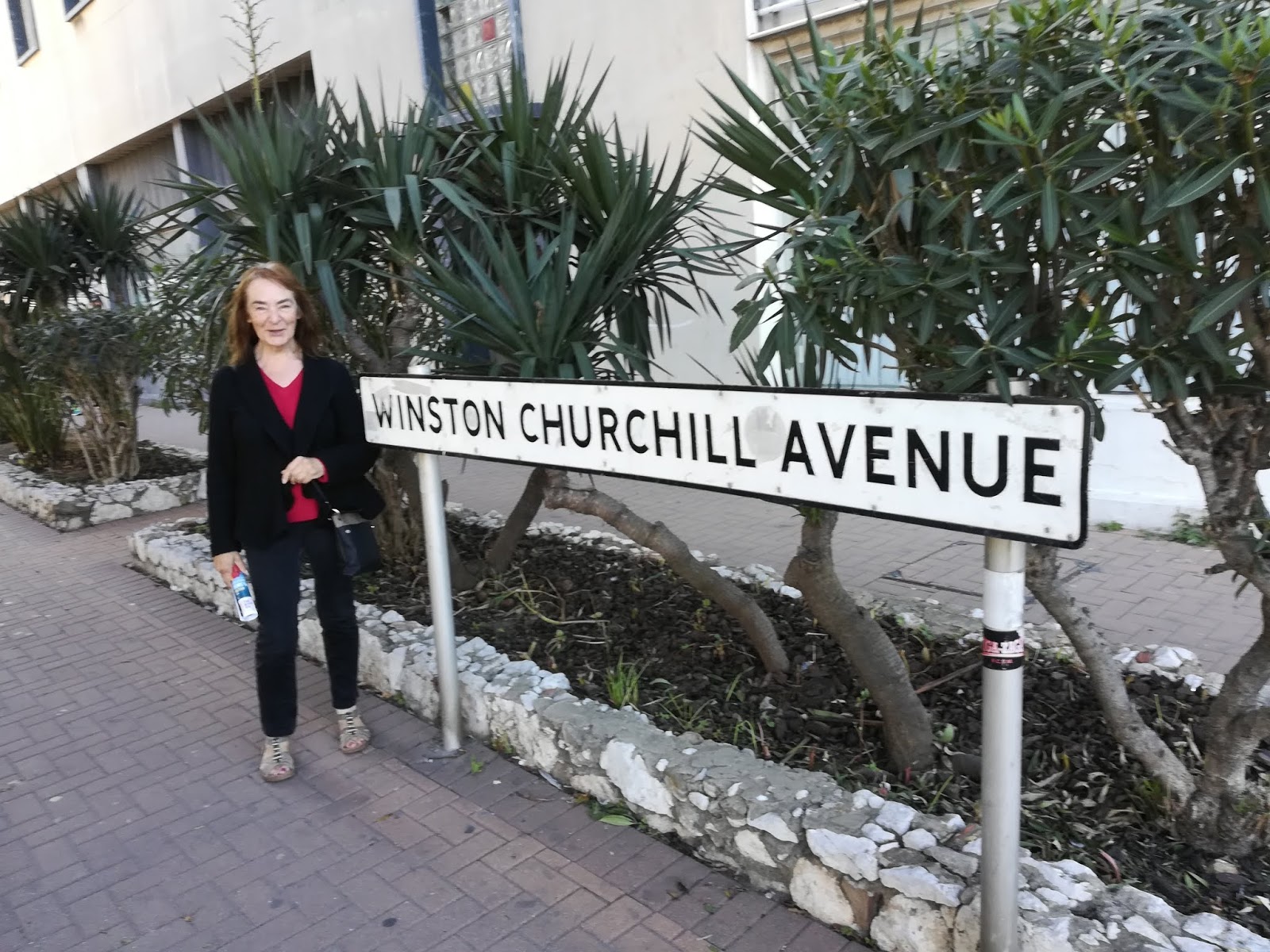

Once there it does seem odd to be spending pounds rather than euros and even odder that they leave the wallet so much quicker. It’s also a little weird to pass Holland and Barret (twice), to observe policemen on the beat wearing the old spiked helmets and to see so many fish and chip shops. I had a huge disappointment though. I entered a pub and asked the smiling barmaid if they sold real ale.

“Sorry love,” she said kindly, “you won’t get that on the Rock. Doesn’t travel you see.”

I refrained from giving her my lecture on Indian Pale Ale and sulkily ate my fish and chips. They were good, though pricey.  Probably much better than a hedgehog baked in a ball of clay. Do gypsies really eat hedgehogs? I’d like to try that – I think.

Monday, 8 October 2018

A letter from Spain – and Sweden


Yes, back in our village of La Fresneda after a 1500 mile (2400 Km) journey taking in Bolton, Belfast, Dublin and a string of delightful towns in France. I have worked briefly in Belfast before, but this was Margaret’s first visit and, with the very definite exception of the city hall, we both found the city to have many fine buildings, though their locations were often marred by overbearing modern constructions. The famous Crown public house was as good as ever and we even managed to grab one of the many secret snugs that are part of its ornate architecture. It was however expensive, understaffed and beset by tourists – like us. We straddled the border with the South for some time and distance but, unable to answer the ‘Irish question’ just then (we did later after a few pints) proceeded to Dublin where I tackled the more amenable task of roofing my son’s large shed.

In that city we had a good night out at a local pub witnessing the Dubliners at their most abandoned. A bacchanalian scene fuelled by the second (yes second) night of Dave and Rachel’s wedding celebration apparently, plus lashing of alcohol of course. At one point Dave took the microphone from the professional DJ. He joked as confidently as a Frank Sinatra, then sang with the force of a Frankie Vaughan.  Meanwhile his five-year-old daughter rushed aimlessly around the vast bar in her bridesmaid dress and a much older and much larger lady roamed around predating lecherously on younger men.

As usual the good ship Oscar Wilde took us to Cherbourg, a dull crossing with very few passengers aboard – though I did meet a young man who professed to be the son of Martin McGuiness who told me that he was returning from a meeting with Jeremy Corbyn, “your future prime minister who will immediately unify Ireland as soon as he gains power without a gun being fired”. No wait, that was on the trip to Belfast. How the mind can play tricks – and so back to my previous blog on the brain. There I introduced the concept of ‘aporia’ and what follows is a comment from a good friend of mine from Sweden who explains it all so much better.

 Your stories remind us that no absolute truths exist. The premise is wrong, i.e. that our brain is first and lastly logical and just a little emotional like the scum on the sea’s waves. Actually, it’s the other way around. This state of our mind has fostered reams of ridicule and we are ourselves delighted in making fun of our brain’s shortcomings. The latest proof of this is Daniel Kahneman’s book Thinking Fast and Slow. After having read it there is just one comment: “so what?”

If we didn’t have any biases, cognitive dissonances or emotions, we would be a completely different animal. Or why not a robot as we are slowly approaching a robot like state of mind from being stereotyped by social media (internet).  Forget biological evolution, which has been overtaken by technological evolution, which is so fast and unpredictable that we have lost control of it. “Earth, we got a problem.”

So why are there no absolute or universal truths? If there had been they would since a long time ago been thought out. We have had to do with our own laws, manmade like time, before and after, limits, endlessness, eternity, etc. just to cope with life.

It is said that libido is the ultimate drive for life, for animals as well as for mankind. Not so, this is where we differ. Our lust to hang on to life and live (long after we lost our libido and money) is our curiosity, to see what’s around the corner (to be transformed to the fly on the wall).
Not knowing anything, just being suspended in the air and revelling in the unfolding of world events that is true happiness. Happiness through aporism. QED!


Wednesday, 19 September 2018

About the brain and us


In 350BC, Aristotle noted that “our senses can be trusted but they can be easily fooled”.

Let me start this with a story that I have told many times. Many years ago my wife and I lived on the edge of the city of Ipswich. You may wonder why we lived there since the house looked out onto one of the sink estates of Ipswich, to our left we had a scrap car yard, and to the right a rubbish dump plus the house had no mains drainage or water – but all that’s another story. The house came with a resident female cat, Jemima, and we adopted each other. After some time the cat became pregnant and gave birth, in my shed, to a delightful litter of kittens. Soon after their birth they were all killed!

A few years later we were revisiting the tragedy and found that we had quite different recollections: in my version our dog, Droopy, had killed the kittens, Margaret recalled that a local tom cat had done the deed. Fortunately I kept quite a detailed diary in those days and was able to refer to my notes. Shock, horror, Margaret was right. My memories of the event, though clear, were false.

We all have false memories some of them pure invention, some distortions. Most people do not believe this, but it is true – and scary. In what can we trust?

Another story. Fairly recently a group of us were shown a video of football game: we were told to watch the player in the black shirt and count how many times he kicked the ball. At the end of the short display we were asked for our answers which were quite varied, but similar. We were then asked, “Did you see superman?” Puzzled, we all said no and the video was replayed and there he was threading his way through the players as large as life! A trick – yes, of the brain. Actually I have changed the players and the intruder in this tale so that this will not be a spoiler if you if you sometime see the original, but hey the brain’s flexible so that’s OK.

In a somewhat related phenomenon your brain filters out the mundane. Its overriding duty is to keep it, and therefore you, safe, and it’s the new, the unknown, and the surprising, that are likely to be dangerous. Hence: a liking for sleeping in one’s own bed, home being where the heart is, blood seemingly thicker than water and so on. However, to the contrary, new environments or challenges steps up the brain’s awareness, hence the stimulation of travel (which ‘broadens the mind’ apparently).

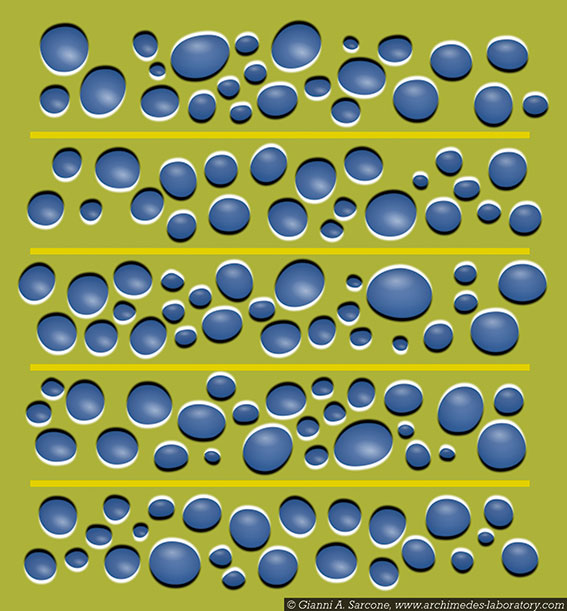
We often need to ‘see for ourselves’ or maintain that we only trust ‘the evidence of our own eyes’. But should we trust that evidence. There are numerous illusions which dramatically prove that our brain messes with reality.  A simple matrix of blobs appears to be moving yet we know that they cannot be, spinning dancers uncannily rotate clockwise or anticlockwise depending on which you set your eyes upon first. And so on and on as more illusions, old and new, are discovered and broadcast over the Web.

Science, one might think, can slice its way through this nonsense to reveal reality. But can it? Much of what is ‘observed’ in modern science is detected by a sensor and relayed to us through a computer which processes the data. We can never see the ‘new’ particles which constitute the things that we actually see, though there was a time when we could observe the tracks of some of the particles in a cloud chamber. Nowadays sophisticated detection and heavy processing sits between the collisions which occur in the Hadron Collider and the graphs that allow physicists to buttonhole the Higgs boson.

There are more and more examples which shake the very foundations of our natural belief in our powers of observation, and yet more can be supplied by philosophers in relation to our powers of reason, meanwhile life goes on. After all, too much doubt in ourselves might cause a collapse of confidence and a resort to instinctual behaviour or a cynical retirement from life itself.

I have a thoughtful friend called Bjorn in Sweden who seems to have found refuge in not knowing and has even found a term to describe his philosophic position which dates back to the Greeks – aporia. Whether aporia  leads to greater clarity or simply defines doubt and confusion, I do not know.  But one thing’s for sure Aristotle was right to say that our senses can be easily fooled – and therefore so can we. I suppose the one thing that we can know for sure is that we don’t know, for sure. However, I’m pretty sure that I am off on my travels in a few days time: Ireland, France, Spain and Portugal.

Saturday, 1 September 2018

Bookend Blues


Haven’t written a blog for ages. Been busy: hopefully honing my writing skills.

One of my regular delights is a negative one: it’s not having to get up in the mornings. I do get up eventually of course, but not at those ghastly hours when I had to catch a train to London or motor up to some outlandish place in the north to attend a meeting or deliver a course. Nowadays, my radio belches out the Today programme on BBC Radio 4 at about 7.30 a.m. and then I just lie about cursing at the aggressive bias of the interviewers until I feel ready to take a run or cycle to the gym.

                                                     bookends | notonthehighstreet.com

It was on such a morning that I heard the announcements concerning this year’s UK exam results for sixteen-year-olds – the GCSEs. Hardly jump out of bed stuff, but it did send me spinning back to my own teens. In my day you received the dreaded results by paper mail. I can remember looking at mine with some disbelief. 

Funnily enough I can remember the exact street in Cheltenham where I studied them. The bearer of this momentous piece of information was devastatingly disappointing: a flimsy slip of paper simply listing subjects and grades, little more than a single shred from today’s shredders. In those days grades were not that important. In ‘O’ levels, as they were called, failure was not encouraged, but it was allowed: it was the number of subjects that you passed that mattered. I did OK - I seem to remember that I got a grade 1 in something; grade 8 was a pass.

Dozing can lead to considerable confusion and listening to the radio I was – confused. Everything seemed upside down as they reported on the year’s results. In previous years they had used letters to represent grades, but this year they had reverted to numbers again. However, grade 9 was the top and grade 1 was the bottom. Seemed odd, and to quote from David Richard Getling who knows more about this stuff and is a little more outspoken than I am : ‘Of course, only someone as intensely stupid as the British government would have invented such a grading system. Top grades have always been 1 or A. We talk of something being first class, or A grade, if it's the best: and this is common throughout the world. So it takes a complete and utter moron to do the opposite.’

Those recent announcements reminded me of how hard I worked in revising for my exams. I can remember the hunted look on the faces of my teachers as exams loomed and I approached them with my incredibly long list of questions in which I tried to understand all the things I should have understood from their lessons. More topically I can recall the longing for the revision and the exams to come to end so that I could be free. Yes free. Free to do what?  Instead of freedom I actually experienced what is best described as bathos, or anticlimax, or post natal depression without the baby.

Finishing reading a good book is a bit like that. Finishing writing a book is exactly like that: hence the title of this blog. Actually I haven’t quite finished, one never does. But the first draft is done, the bathos then has two sources. First, during the very creative part of researching and writing there aren’t enough hours in the day: in other words there is always something to do – and a deadline to meet. And second, now that the baby is born, one becomes protective, yet critical. Is it any good? Wouldn’t it have been much better structured in a different way? Does the title do it justice? If I start fiddling with it, will the panoply collapse and all the cross references go astray?

Though I often self-publish, this one goes off to the publishers. More worries. Is it ready? Will they like it? Is it what they thought it would be? Will their editors tear it apart and bastardise it.

Hey, ho. The journey’s been good though. There should be a song The Bookend Blues. I’ll make a start on the lyrics right now, but then would I be happy with them?